John Singer Sargent, Paris, and the Story of Madame X
- Jonathan Clark
- Apr 10
- 6 min read


Among the great artists of the 19th and 20th centuries, few can compare to John Singer Sargent. His portraits have made a lasting impression, showing a depth of humanity that few works of art have ever achieved. At the same time, his brushstrokes appear effortless, as if he simply channeled all that he saw, preternaturally capable of capturing life on a canvas.
Of course, his marvelous works like Portrait of Madame X tell us a great deal of his story, but there is so much more underneath. He was a gay man at a time when homosexuality was forbidden. He was an American living in Europe who trained with the very best in Paris. He was a portrait artist of high society who fled scandal throughout his life.
Today, we look at his work, and we see mastery. And if we really know how to look, we also see the story of a painter who learned profound lessons from the French Impressionists, who long languished in relative obscurity until critical reappraisal in the late 20th century.
If you’d like to learn more about French Impressionism, what better way than to see it firsthand with our private, guided tours of the Musee d'Orsay? Combine it with a trip to the Orangerie to see the greatest Impressionist paintings in the world.
For now, let’s dive into the life and experience of this transcendent artist in Paris.
The (Surprisingly Parisian) Story of John Singer Sargent
John Singer Sargent was born in Florence, Italy, to American parents who were traveling the world to process the grief of losing their daughter when she was only two years old.
Soon, the family not only gave birth to John in 1885 but also to his younger sister the following year. The family decided to live on their inheritance and savings, moving through Europe as a way of life. This gave young John remarkable access to the museums and art of the continent.
By the time he was a teenager, his abilities were readily apparent. There was little doubt that he would take this uniquely cosmopolitan life experience and turn it into a magnificent career in art.
An Art Student in Paris
Sargent enrolled in the École des Beaux-Arts in 1874, the same year that the Impressionists had their first exhibition, which would lead to open rebellion against the Academy that the young artist was only just enrolling in.
But unlike the stodgy Jean-Léon Gérôme, who was teaching his students the traditional ways of painting, Sargent benefited by studying under Carolus-Duran (a great portrait artist in his own right), who taught his students to paint wet-on-wet (or alla prima), a more fluid and relaxed style that didn’t rely on such rigid devotion to the underpainting. It was a technique first popularized by Diego Velázquez—whose work Sargent would see firsthand on a pilgrimage to Spain.

Sargent proved to be a quick learner, mastering the wide-open potential this form of painting offered the artist at any given moment. This, along with the Impressionist artwork that was the talk of Paris at the time, left an indelible mark on Sargent's development.
The French Artists that Influenced John Singer Sargent
There was a staggering number of legendary artists active in Paris at the time of Sargent’s coming-of-age. The young painter was notoriously open-minded, soaking up the vast brilliance on display. For him, there were no contradictions between taking in the very best of traditional French painting and the avant-garde. This synthesis led to the distinct formal strength and gestural freedom of his work.
It’s worth taking a moment to understand in detail some of the larger influences on Sargent’s work at the time.

Claude Monet: Sargent met Monet at the second Impressionist exhibition in 1876. At this show, Monet offered the highly uncharacteristic La Japonaise (1876). This is a full-length portrait that captures the rage of Japonisme in Paris as well as a well-trained flourish of brushstroke. In other words, this was a full-length portrait of a woman that combined high fashion and Impressionist technique—all of which would soon become the calling card of Sargent. On another note, Monet submitted 17 other paintings at that exhibition, including the famous Woman with a Parasol (1875).Despite this connection, Monet himself distanced the French Impressionist movement from the likes of Sargent, saying, "He is not an Impressionist in the sense that we use the word; he is too much under the influence of Carolus-Duran." (Check out our Claude Monet tour here.)
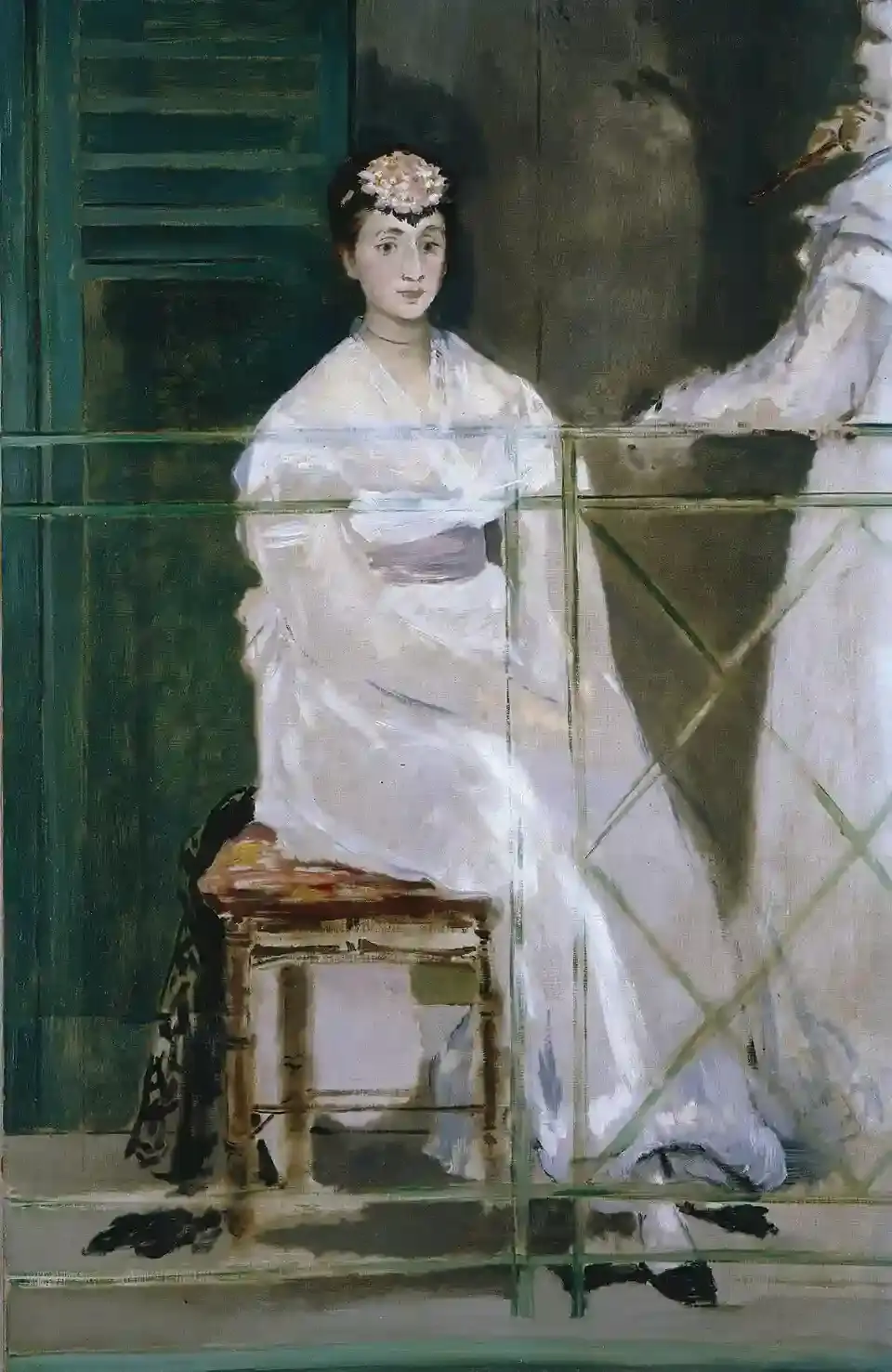
Mademoiselle Claus (1868) by Edouard Manet Edouard Manet: Manet influenced many painters in Paris and beyond throughout the second half of the 19th century, and Sargent was no different. In fact, we know that Sargent purchased a Manet painting in 1883 (the stoic portrait Mademoiselle Claus from 1868), when the elder artist had died. This work was completed more than a decade before Sargent enrolled in art classes. And it bears a striking resemblance to Sargent’s greatest achievements. Looking at this portrait by Manet, one that Sargent had shipped all the way over to England, where he was living at the time of purchase, we can see a clear trajectory from one artist to the next.
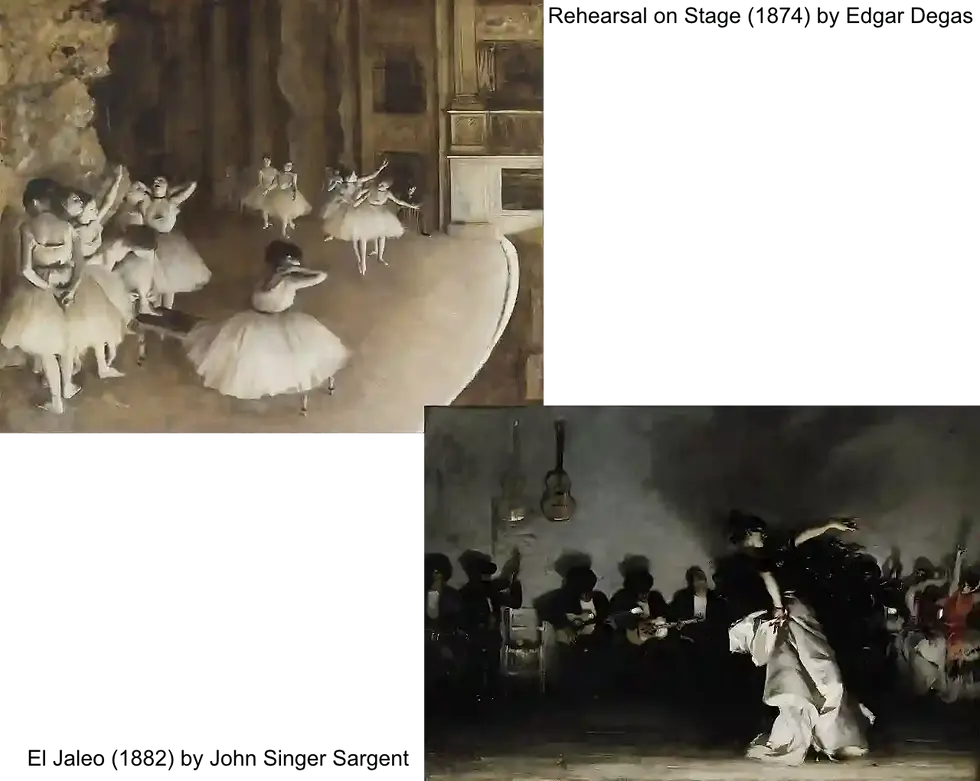
Edgar Degas: Degas offered a Sargent a guide for developing a visual language, but his work also gave the young artist permission to take up music as a central influence on his painting. Degas’s entire oeuvre, after all, is so intricately linked with the stage, and Sargent would turn to the world of classical music as subject matter for his entire career (consider Sargent's stunning 1882 effort El Jaleo). Sargent witnessed Degas’s work through the 1870s, giving him a powerful example to draw from. The two artists have clear affinities in their treatment of light and their ability to capture the fleeting essence of a person.
Want to learn more about Monet, Manet, and Degas? Consider our private, guided tours of the Musee d'Orsay, where you will see the greatest works of Impressionism firsthand.
This can be combined with a visit to the Orangerie, where we can see the unbelievable display of Monet’s Water Lilies series.
Sargent, the Toast of Paris
Sargent burst onto the art scene at the tender age of 23 with a portrait of his painting teacher Carolus-Duran entering the Paris Salon in 1879. The response was electric. And portrait commissions began to keep him afloat.
Sargent was well-suited for this position. His wide travels as a child made him a fascinating conversationalist, and his French was impeccable. This, combined with his ferocious work ethic, allowed him to deliver commissions on schedule and keep up with high demand.
He continued to present these portraits in the Salon, giving him a well-respected name — even if the subject matter was a bit tame. In fact, the real genius shimmering underneath in these works has really only recently been explored by the art world. At the time, he was seen as great but not visionary. Still, he was the only painter who could keep up with the changing sensibilities of French fashion at the time.
That all changed with a scandal.
Madame X and Sargent’s Exit

In 1884, Sargent completed Portrait of Madame X — the work he believed to be his best.
It was of Madame Pierre Gautreau, and Sargent tracked down the commission himself. He chased after her, wanting to capture her charisma on canvas.
He got the opportunity, and over the course of a year, he crafted a compelling vision of the modern woman. Her neckline? Plunging. Her attitude? Fierce. The composition? Dramatic.
The overall effect was unlike the staid portraiture of generations past. Here was a statement: the arrival of an artist alongside an entirely new way of being a woman.
It appeared in the Paris Salon, where it was mobbed by crowds who jeered at the sight of such a painting. Sure, some defended it, but the overwhelming response was negative.
Overnight, the commissions dried up, and Sargent found himself in dire straits. He overpainted one of the shoulder straps on the work, making sure it appeared a bit more fastened, but the damage to his reputation was done.
He moved to England, where his career recovered. The Metropolitan Museum of Art in New York City purchased the painting in 1916, where it remains a part of their permanent collection.
A Painter, a City, a Masterpiece
Today, we look back at Madame X for what it is: the perfect encapsulation of an era. It is Paris of a certain time, where the world was shifting and those who thrived had to take on a little bit of arrogance, a little bit of seductive charm. The painting seems to declare a new age, combining the very best of the long tradition of Academic painting with the revolutionary styles just coming into vogue at the time.
The painting, then, is a crossroads. For the painter, it was the choice to follow his instinct and move beyond his life as a portrait artist for the wealthy, a choice that would force him to leave Paris but also embrace a new freedom that would lead to his now legendary career. For Parisian society, it is the split from an industrializing city into one totally transformed by the rise of modernity. For painting, it was the new possibilities made possible by new styles, which were now coming into their own as influences that would forever reshape the art world.
Love French art history? Why not see it for yourself on your next trip to Paris? Contact us today, and we can begin to craft a bespoke guided tour of the great art museums of the City of Lights — all made just for you.


Comments